









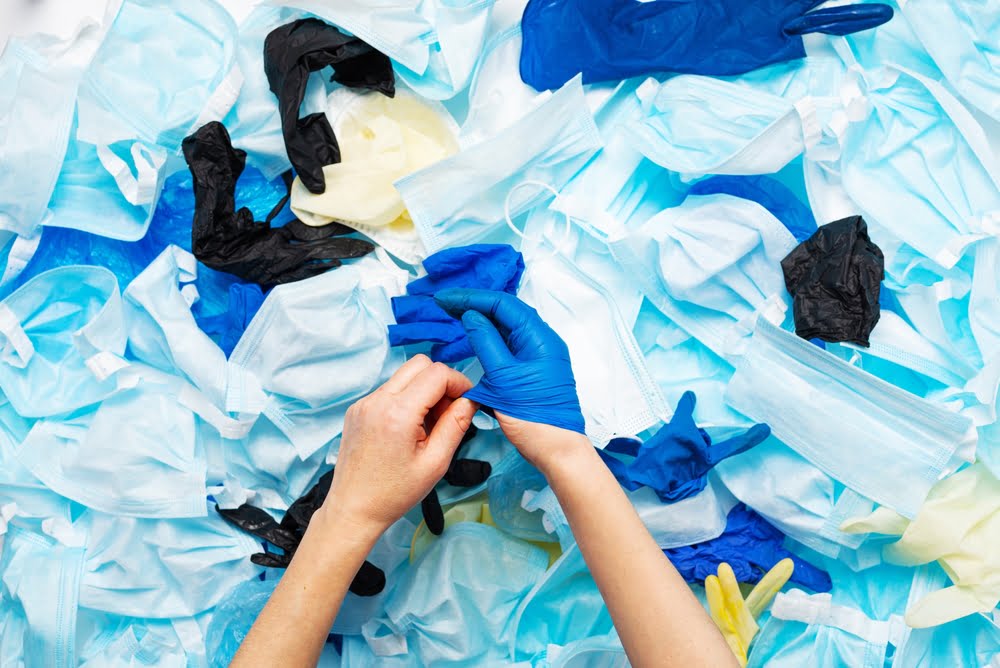
Engineers at RMIT University have developed a method to use disposable personal protective equipment (PPE) to make concrete stronger, providing an innovative way to significantly reduce pandemic-generated waste.
The RMIT team is the first to investigate the feasibility of recycling three key types of PPE – isolation gowns, face masks and rubber gloves – into concrete.
Published in the journals Case Studies in Construction Materials, Science of the Total Environment and Journal of Cleaner Production, the studies by RMIT School of Engineering researchers demonstrate the potential for PPE to be used as reinforcement materials in structural concrete.
The studies found shredded PPE could increase the strength of concrete by up to 22 per cent and improve resistance to cracking.
The RMIT School of Engineering team’s industry partner is planning to use these research findings in a field project.
Since the start of the COVID-19 pandemic, an estimated 54,000 tonnes of PPE waste has been produced on average globally each day. About 129 billion disposable face masks are used and discarded around the world every month.
First author, PhD researcher Shannon Kilmartin-Lynch, said the research brought a circular economy approach to the challenge of dealing with healthcare waste.
“We urgently need smart solutions for the ever-growing pile of COVID-19 generated waste – this challenge will remain even after the pandemic is over,” said Kilmartin-Lynch, a Vice-Chancellor’s Indigenous Pre-Doctoral Fellow at RMIT.
“Our research found that incorporating the right amount of shredded PPE could improve the strength and durability of concrete.
Joint lead author, Dr Rajeev Roychand, said there was real potential for construction industries around the world to play a significant role in transforming this waste into a valuable resource.
“While our research is in the early stages, these promising initial findings are an important step towards the development of effective recycling systems to keep disposable PPE waste out of landfill,” he said.
Strength and flexibility
In three separate feasibility studies, disposable face masks, rubber gloves and isolation gowns were first shredded then incorporated into concrete at various volumes, between 0.1 and 0.25 per cent.
The research found:
- rubber gloves increased compressive strength by up to 22%
- isolation gowns increased resistance to bending stress by up to 21%, compressive strength by 15% and elasticity by 12%
- face masks increased compressive strength by up to 17%
Corresponding author and research team leader Professor Jie Li said PPE waste – both from health care and the general public – was having a significant impact on the environment.
“We have all seen disposable masks littering our streets, but even when this waste is disposed of properly it all ends up in landfill,” Li said.
“With a circular economy approach, we could keep that waste out of landfill while squeezing the full value out of these materials to create better products – it’s a win on all fronts.”
The next step for the research is to evaluate the potential for mixing the PPE streams, develop practical implementation strategies and work towards field trials.
The team is keen to collaborate with the healthcare and construction industries to further develop the research.


