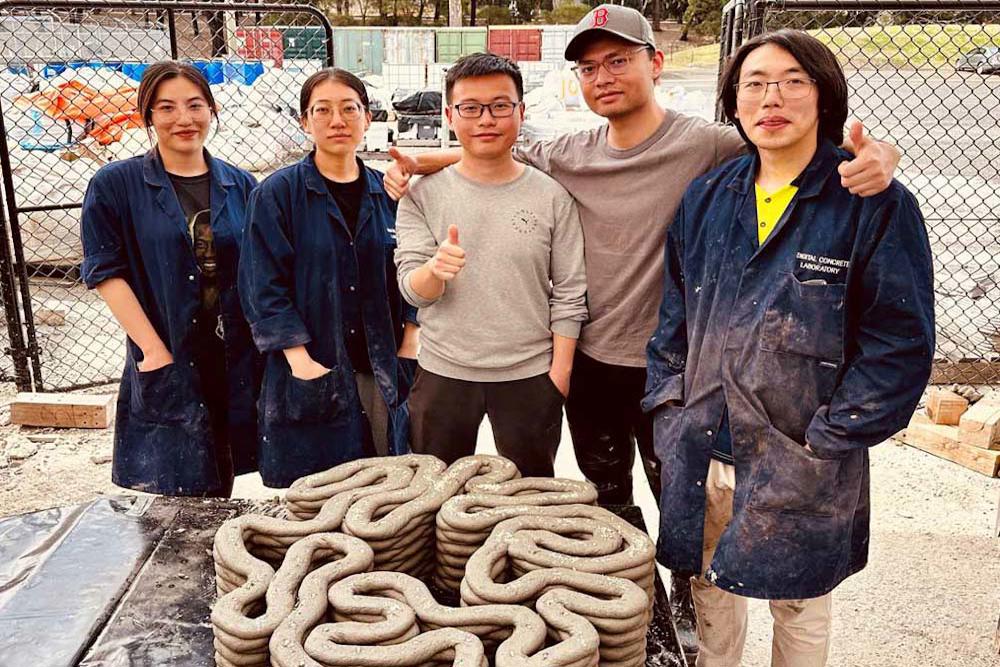
Engineers from RMIT University and the University of Melbourne have added graphene oxide to cement mixture to make stronger 3D printed concrete that is easier to print — paving the way for the creation of potential ‘smart’ walls that can monitor structural cracks.
The research conducted by both universities is the first to investigate the effects of graphene oxide on the printability and compressive properties of 3D printed concrete.
It found the addition of graphene oxide — a nanomaterial commonly used in batteries and electronic gadgets — gave concrete electrical conductivity and increased the strength of concrete by up to 10 per cent.
Research supervisor and RMIT Associate Professor Jonathan Tran said the concrete had the potential to create ‘smart’ buildings where walls can act as sensors to detect and monitor small cracks.
While current detection methods, such as ultrasonic or acoustic sensors, are non-destructive and widely used in the construction industry to detect large cracks in concrete structures, detecting smaller cracks early is still a challenge.
Tran said: “The equipment for these methods is often bulky, making it difficult to regularly use for monitoring very large structures like bridges or tall buildings.
“But the addition of graphene oxide creates the possibility of an electrical circuit in concrete structures, which could help detect structural issues, changes in temperature and other environmental factors.”
Tran said graphene oxide had the exciting potential to make 3D printed concrete more viable in the construction industry, which could have positive impacts on cost and sustainability.
Current concrete structures require a mould referred to as ‘formwork’, these are labour-intensive, timely and costly to make — plus they create a lot of waste.
“With 3D printed concrete, not only does it help save time, money and labour, but you can also create more complex structures and reuse some construction waste in cement-based materials.”
As 3D printed concrete uses layer-by-layer printing, it can potentially lead to weaker bonds between each layer, but the addition of graphene oxide in concrete makes it easier to extrude, creating better inter-layer bonding, which can also help maximise strength.
“Graphene oxide has functional groups on its surface, which are like sticky spots on the surface of a material that can grab onto other things.
“These ‘sticky spots’ are mainly made of various functional groups containing oxygen, which play a crucial role in facilitating its stronger bonds with other materials like cement. This strong bonding can improve the overall strength of the concrete.
“However, more research is needed to test if concrete with graphene oxide can match or surpass the strength of traditionally cast concrete,” said Tran.
Lead researcher RMIT PhD candidate Junli Liu said the strength of the concrete could be increased if the bond between graphene oxide and the concrete mixture was improved.
Tran said adding too much graphene oxide could impact the strength and workability of the concrete mix, which can cause potential issues with printability, strength and durability.
The next phase of the research will study the electrical conductivity of graphene oxide in concrete and test its viability as a potential smart material.