

Climate Action 100+, the world’s largest investor engagement initiative on climate change, has released its first-ever benchmark evaluating the corporate ambition and action of the world’s largest greenhouse gas (GHG) emitters and other companies with significant opportunity to drive the net-zero transition.
The Climate Action 100+ Net-Zero Company Benchmark offers the first detailed, comparative assessments of individual focus company performance against the initiative’s three high-level commitment goals: reducing GHG emissions, improving governance, and strengthening climate-related financial disclosures.
The benchmark defines key indicators of success for business alignment with a net-zero emissions future and the goal of the Paris Agreement to limit global temperature rise to 1.5- degrees Celsius.
While there is growing global momentum around companies making ambitious climate commitments, the benchmark assessments show that companies still have a long way to go in delivering on these promises.
No focus company assessed performed at a high level across all of the nine key indicators and metrics that were used to evaluate each company.
Further, the assessments show that no company has fully disclosed how it will achieve its goals to become a net-zero enterprise by 2050 or sooner. This includes establishing short and medium-related targets to deliver ambitious emissions reductions within the next decade.
While some companies in a range of sectors are ahead of their peers in making progress towards some of the disclosure and decarbonisation strategy indicators, all companies have more work ahead. Specifically, the company assessments reveal that:
Alignment of value chain GHG (Scope 3) emissions often remains a blind spot.
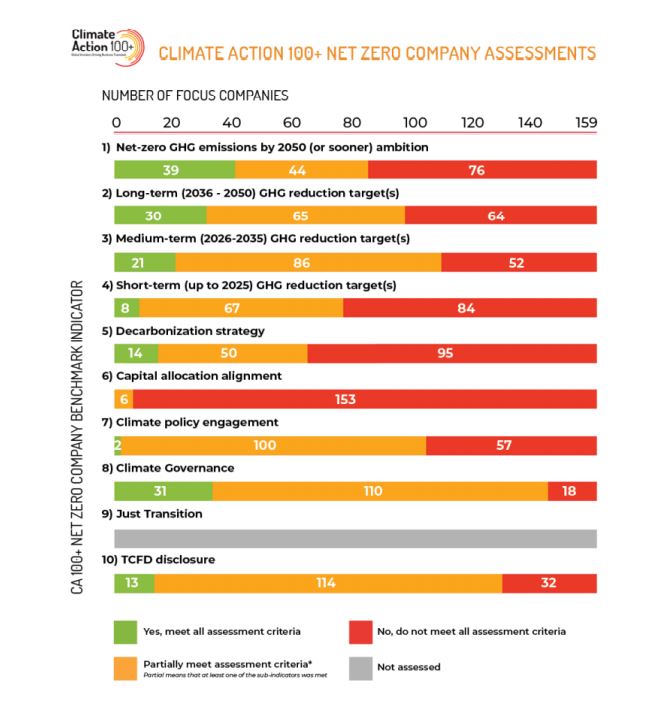
Overall, 83 of the focus companies (52 per cent of the total) assessed have announced an ambition to achieve net-zero by 2050 or sooner. However, roughly half of these commitments (44) do not cover the full scope of the companies’ most material emissions.
Long-term ambitions need to be backed by clearer strategies and robust short-and medium-term targets.
There is a critically important need for corporates to establish more robust short-and medium-term targets to achieve their ambitions;
While 107 companies have set medium-term targets (2026-2035), only 21 meet all assessment criteria; 75 companies have set short-term targets (up to 2025), but only eight meet all assessment criteria.
Future investments need to be more clearly aligned with the net-zero transition.
Only six companies explicitly commit to aligning their future capital expenditures with their long-term emissions reduction target(s), and none of these companies has committed to aligning future capital expenditure with the goal of limiting temperature rise to 1.5 degrees Celsius.
Corporate boards and executive management teams need to improve climate change governance.
139 focus companies assessed (87 per cent) have board-level oversight of climate change, but only a third of companies tie executive remuneration directly to the company’s emission reduction targets.
Ambitious 1.5-degree pathways are often missing from climate scenario planning.
Almost three quarters (72 per cent of the total) of companies assessed commit to align their disclosures with the Task Force for Climate-related Financial Disclosures (TCFD) recommendations and/or support the recommendations.
However, only 10 per cent use climate-scenario planning that includes the 1.5-degrees Celsius scenario and encompasses the entire company.
The benchmark does not specifically score or rank companies, nor does it use overall numeric or alphabetic ratings.
Leading climate research and data organisations, including Transition Pathway Initiative (TPI), Carbon Tracker Initiative (CTI), 2° Investing Initiative (2DII) and InfluenceMap (IM) have been central to the overall development of the new benchmark and the indicators used to assess focus company alignment with the initiative’s goals.
TPI conducted the company disclosure research and analysis, supported by its research and data partners the Grantham Research Institute on Climate Change and the Environment at the London School of Economics (LSE) and FTSE Russell.
The benchmark was undertaken through the leadership and support of the Climate Action 100+ Steering Committee, and the collaboration of investor signatories and experts from AIGCC, Ceres, IIGCC, IGCC, and PRI.
The benchmark provides the $54 trillion investor-led initiative that seeks greater climate ambition and action from corporate boards and executives with a ground-breaking tool, and a mechanism for tracking corporate progress.
It has been designed to add further depth to investor expectations of corporate progress, and inform and improve investor engagement strategies to drive faster climate action.
Where relevant, company engagements include shareholder activity during upcoming annual general meetings and beyond. Additionally, the benchmark aims to define the key elements of a robust ‘net-zero aligned’ business strategy.
The relatively low performing companies reflect the fact that most of the world’s largest companies are still in the early stages of the shift to a net-zero economy.
In bringing much-needed clarity to what a ‘net-zero aligned’ business strategy entails, the benchmark helps to set the baseline against which future delivery can be assessed.
Over the coming months, Climate Action 100+ will build on the company assessments released today by publishing sector by sector analyses.
The benchmark will continue to evolve as a key measure of corporate progress on climate action and net-zero alignment, and will be updated and revised with the latest available data, and stakeholder input and feedback.
The next iteration of the benchmark will be published in 2022.
Company assessments can be found here.
Background
On behalf of Climate Action 100+, TPI assessed 159 focus companies assessed across nine key indicators.
The indicators assessed companies on an objective, consistent basis, and were designed to be applicable to different regional markets and to a wide range of sectors, and are as follows:
- Net-zero greenhouse gas (GHG) emissions by 2050 (or sooner) ambition
- Long-term (2036-2050) GHG reduction target(s)
- Medium-term (2026-2035) GHG reduction target(s)
- Short-term (up to 2025) GHG reduction target(s)
- Decarbonisation strategy
- Capital allocation alignment
- Climate policy engagement (includes InfluenceMap’s detailed corporate climate lobbying analysis)
- Climate Governance
- Task Force for Climate-related Financial Disclosure (TCFD) recommendations
CTI and 2DII analysed companies’ capital expenditures (CapEx) and technology mix to provide additional insights on decarbonisation investments. Both organisations used independent methodologies and asset-level inventory data sources which vary depending on the sector.
These additional insights were included in the assessments for companies in the oil and gas, electric power, and automotive sectors.
The company assessments were based on the public disclosures provided by companies.
Companies were informed about the indicators in September 2020, and were provided with the results of their draft assessments in mid-December 2020.
Companies were able to provide additional/supplementary information by 22 January 2021, and TPI updated its assessments based on this information.
Any actions taken or information provided after this date will be considered in future iterations of the benchmark.
Eight of the initiative’s 167 focus companies (Grupo Argos SA, Grupo México, Incitec Pivot, Oil Search, Orica, Petróleos Mexicanos – PEMEX, Saudi Arabian Oil Company (Aramco), and UltraTech Cement Ltd) were not assessed in this benchmark given they were added to the Climate Action 100+ focus list in November 2020. However, they will be included in future iterations of the benchmark.
About Climate Action 100+
Climate Action 100+ is an investor initiative to ensure the world’s largest corporate GHG emitters take necessary action on climate change.
More than 575 investors with $54 trillion in assets collectively under management are engaging 167 focus companies to improve governance, curb emissions, and strengthen climate-related financial disclosures.
The companies include ‘systemically important emitters’, accounting for 80 per cent of annual global industrial emissions, alongside other companies with significant opportunity to drive the clean energy transition.
Launched in 2017, Climate Action 100+ is coordinated by five investor networks: Asia Investor Group on Climate Change (AIGCC); Ceres (Ceres); Investor Group on Climate Change (IGCC); Institutional Investors Group on Climate Change (IIGCC) and Principles for Responsible Investment (PRI).
These organisations, along with five investor representatives from AustralianSuper, California Public Employees’ Retirement System (CalPERS), Gam Investments, Ircantec, and Sumitomo Mitsui Trust Asset Management form the global Steering Committee for the initiative.