





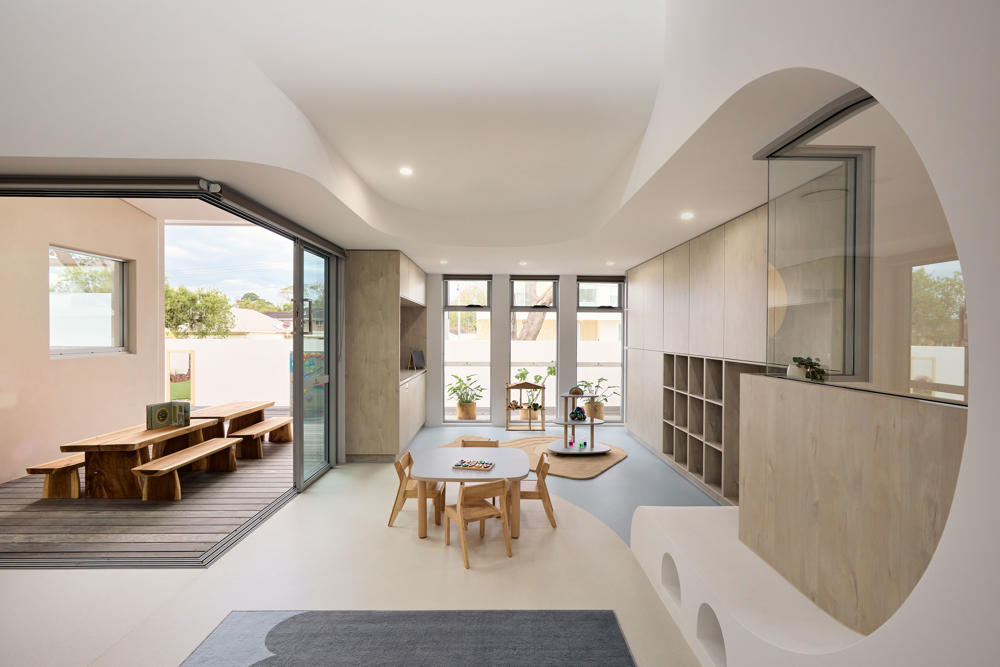
A newly completed early learning centre in Caringbah, south of Sydney, is drawing attention for its distinctive use of curved architecture, marking a departure from the boxy, utilitarian interiors typically associated with childcare facilities.
The 350 square metre fit-out at Little Seeds Early Learning Centre was designed by Sherif Saad, Director of ArtMade Architects, who brought 25 years of experience in early learning, childcare and kindergarten design to the project.
Sherif was engaged to deliver the construction certificate, construction drawings and interior design for the space, which caters to children up to five years of age, along with their caregivers and educators.
The brief called for an interior that felt welcoming, relaxing and unique.
To achieve this, Sherif built the design around curvature, applying it consistently across the centre’s various zones.
This approach ranges from a large, curved feature wall to smaller curved nooks positioned at ground level, designed specifically for young children to explore.
Cool tones and round windows complete the interior, creating spaces that shift with natural light throughout the day.
Designing for early learning centres presents a distinct set of challenges compared with other commercial interiors.
The layout must accommodate infants, toddlers and older children, all of whom interact with a space differently depending on their age and stage of development.
Operational needs for educators and the day-to-day movement of caregivers through the centre also had to be factored into the design.
Using curvature throughout enabled the team to unify the design across a myriad of spaces.
Material selection was another key consideration, with an emphasis on durability and ease of maintenance.
Laminated timber, vinyl flooring in the playrooms and wall tiles in wet areas were all specified to withstand the daily demands of a childcare environment while supporting the overall aesthetic.
The prevalence of curved geometry in the design has historical roots. According to Sherif, curved forms have long featured in architecture, tracing back to influences from ancient Rome and Greece.
He notes that the appetite for this style of design has grown in recent years, partly due to advances in laser cutting technology, which now allow curves to be fabricated with greater precision than in the past.
The project was constructed by Moatez Ramadan of Alexandria Building Group, known as ABG Constructions, with his wife overseeing the operational side of the Little Seeds business.
Moatez noted that feedback from parents has centred on the contemporary feel of the space, with many commenting on how elevated and distinctive the interior appears compared with other childcare facilities they have visited.
The Little Seeds Early Learning Centre stands as an example of how thoughtful interior design, grounded in practical material choices and a clear architectural concept, can shape the everyday experience of young children, their families and the educators who work with them.
As demand for high-quality early learning environments continues to grow, projects like this one point to a broader shift in how the sector approaches design, treating it not as an afterthought but as central to the wellbeing of the children who use these spaces every day.